This case study focuses on a single module of the Program Management product.

Purchased by
+4 Agribusinesses
Time Savings
Months to Weeks
Contracted Annual Recurring Revenue
+$300,000
Low Net @ AgVend
Translating a complex agribusiness workflow to calculate true product cost (Low Net) into a seamless, manageable solution, helping users reduce time from months to weeks with fewer errors.
Role
End-to-end product design
Year
2025, Release in Q1 2026
Tools
Figma, Figma Design Systems
AI
ChatGPT, Figma Make
PROBLEM
Our customers calculate their Low Net by manually updating cumbersome Excel sheets, taking months to make changes, often with missed discounts.
From user research we conducted with customers of different scales, we found existing solutions were to either use Excel, which meant manually updating information and dealing with 1,000's of rows and dozens of columns, or using a custom-built solution which was built on legacy technology and unintuitive. These challenges tangibly meant that customers took months to calculate the low net for each product and would sometimes miss thousands in rebate dollars. Having accurate Low Net is vital in ensuring that products are priced competitively.


Artefacts created to ensure a deep understanding of the problem space.
INITIAL FINDINGS
Conducted extensive user research with customers of varying scales to review their unique process, pain points, and current solutions.
I conducted extensive user research through remote interviews with our customers. To synthesize findings quickly and accurately, I created a Custom ChatGPT, where I uploaded all of our transcripts and notes, then had the GPT act as a Low Net end-user. Along the way, I reviewed existing solutions, such as a competitor product (SmartWyre) and some of the custom solutions our customers currently use. These findings highlighted three key elements: we needed a way for our customers to take action in-bulk, let them drill into details when needed, and provide a way to compare their planned vs actual low net.


Figma Make generated explorations to help users compare planned values vs actual values.
CONSTRAINTS
Our process to make manufacturer and distributor rebates machine-readable is manual, resulting in wait time before users upload information to when it's usable.
When a user uploads their rebate information, our process takes time before it is usable in the Low Net planning stage. This delay can cause issues as users want to find and configure their low net before the season starts and their customers begin purchasing. To help reduce this delay, I designed a settings page that allows users to configure these rebates on an ongoing basis. Once a rebate is ready, they can go into the setting page for Low Net and turn it on or off in a couple of clicks, impacting their Low Net cost for any related products, reducing planning completion time.

Guided setup to help reduce cognitive load and ensure users see relevant information critical to their planning process.
PROCESS
Working towards an MVP through continuous iteration, honed by further user research and a ChatGPT Persona.
I created prototypes for testing purposes and leveraged our design system, Figma Make, and ChatGPT for further efficiency. Figma Make helped me quickly generate exploratory ideas for new components we would need, such as the table comparison view, a critical piece that allows users to compare how accurate their plan was to the actual transactions. I worked closely with the design team to ensure we were updating our design system and to find any opportunities to provide platform-wide value.

Planning view with robust filters, simplified details relevant to planning, and links to product details.
OUTCOMES
Releasing a solution that reduces time from months to weeks and helps ensure more accurate pricing.
Collaborating in a cross-functional team of engineers and product managers helped me ensure that my solution was technically feasible, scalable, and balanced our business objectives and user needs. This also helped me cover all edge cases, interactions, and find any technical constraints early. Throughout, I continued to meet regularly with our customers and end-users to refine and tweak our approach, ensuring we delivered value and helped save them time, provided more accurate results, and let them price their products competitively.

Product details with quick toggles to impact planned low net.
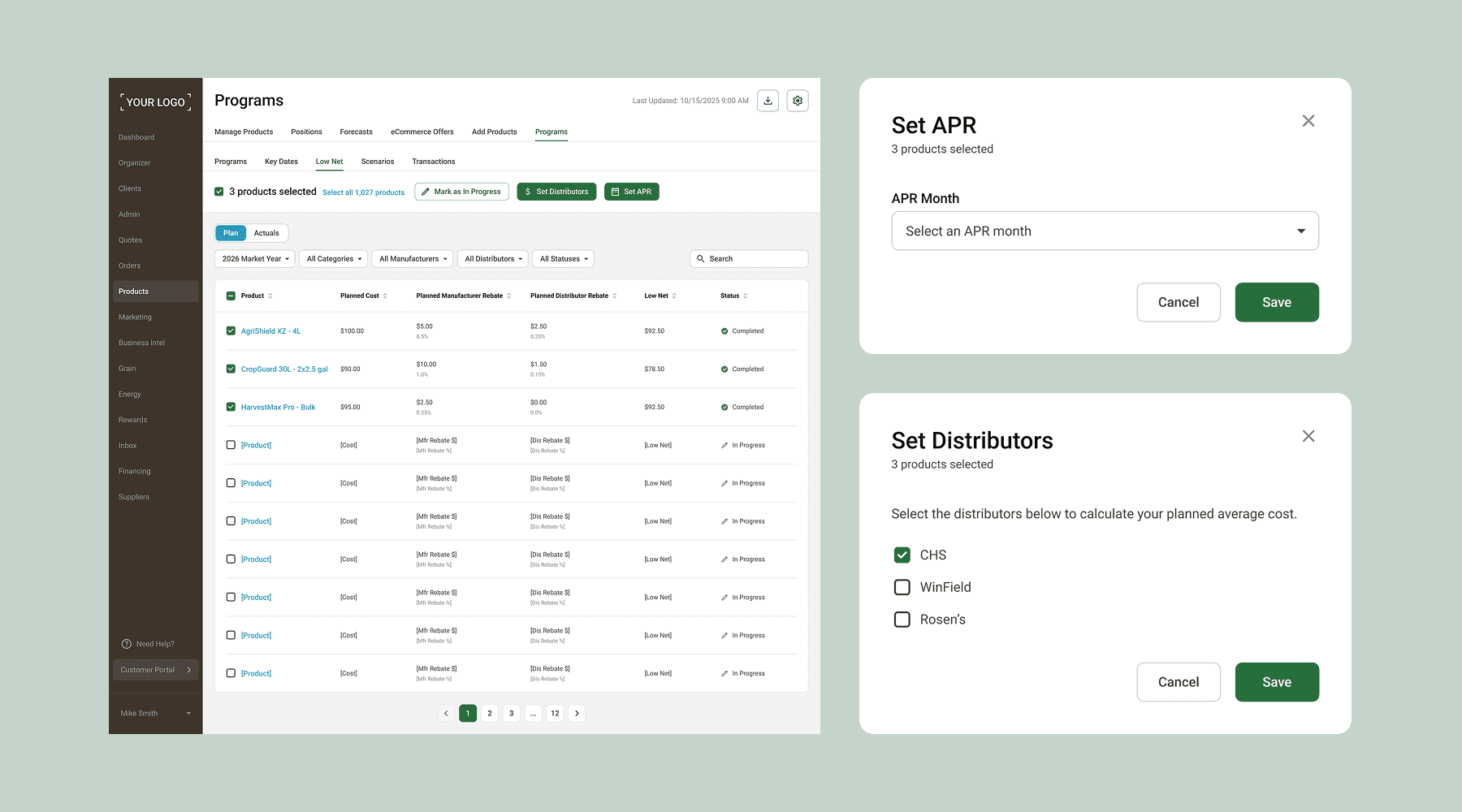


Bulk actions to help users complete planning faster and with more accuracy.

Planning vs Actuals comparison view, this allows users to see how accurate their plan is.

Product details for actuals, a quick overview of how much rebate may be earned on that product and from which offers.
Case Studies


Open Shift Manager @ Infor
End-to-end design of an unfilled shift dashboard to help enterprise scheduling teams reduce unassigned shifts with more visibility and flexibility.


Labour Forecasting @ Infor
Helping enterprise scheduling teams plan for future staffing needs by designing an easy-to-understand and accessible labour forecasting tool.