
Adopted By
+2 Healthcare Authorities
Internal Alignment
Future of Forecasting at Infor
Labour Forecasting @ Infor
Redesigning the Workforce Management Labour Forecasting module to increase usage and value through an easier-to-use, intuitive tool any user can get started with.
Role
End-to-end product design
Year
2024, Release in October 2024
Tools
Figma, Figma Design Systems, Jira, Charting Libraries
PROBLEM
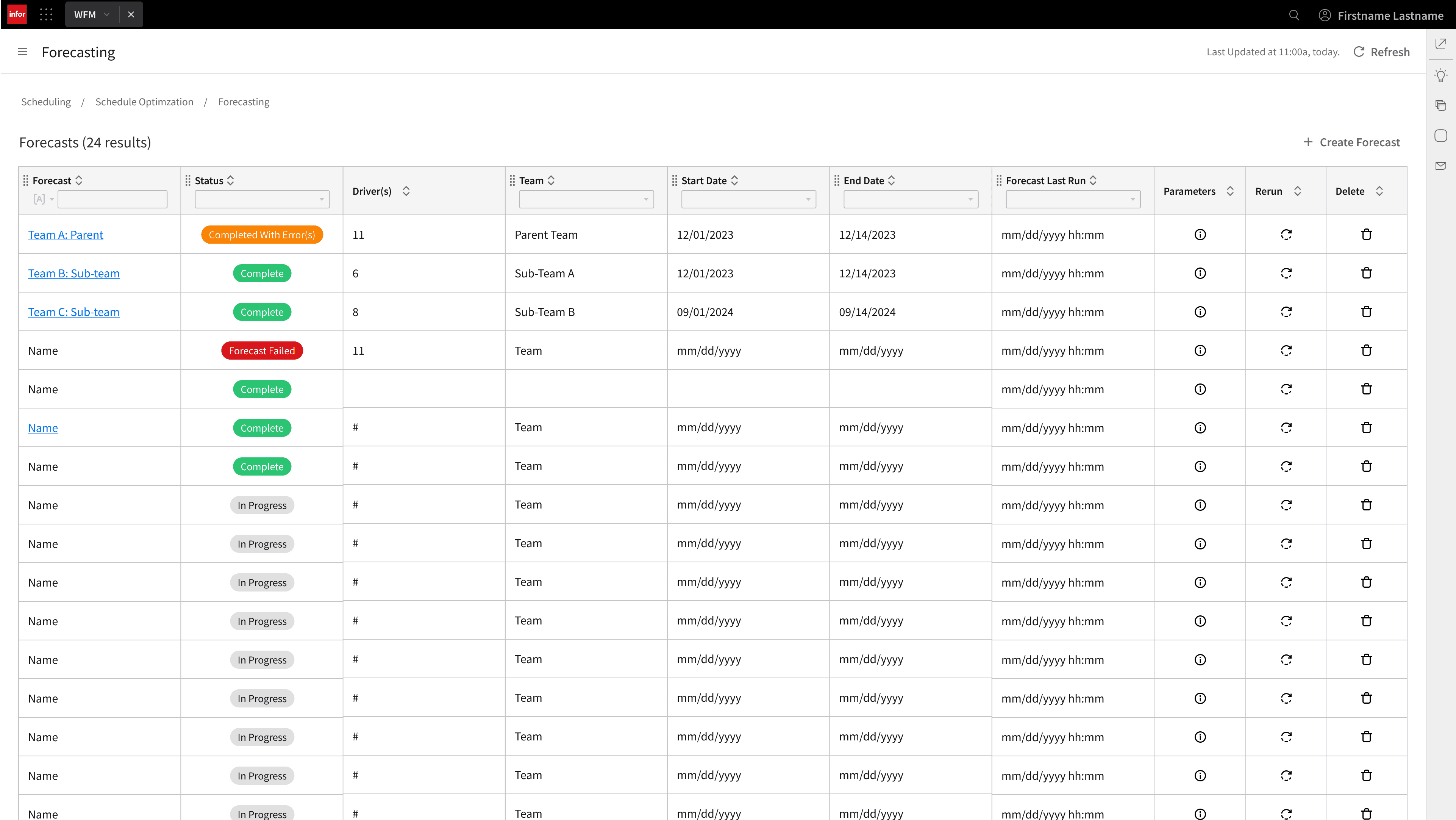
The existing forecasting module is cumbersome and unintuitive, making it a point of friction in the scheduling workflow.
The existing forecasting module was disconnected from the primary scheduling workflow, involving multiple steps to set up and ingest the results. The results themselves were not user-friendly either, displayed as tabular data that made seeing trends at a glance difficult. Through initial user research and conversations, we learned that there was a strong desire for schedulers to use the forecast to help inform scheduling needs, but these users didn't see the value in the existing module and relied on IT Administrators to share results.

PROCESS
Began with a usability audit of the existing module, extensive competitor analysis, and user research to understand pain points and potential workflow value.
I started with a deep-dive with an internal subject matter expert to understand how the module is currently used by customers and the technology behind it. I also conducted a usability audit and competitor analysis to see how other Workforce Management solutions design a seamless flow of forecasted labour to shift planning. These insights helped me have meaningful and productive conversations with customers to understand how they currently conduct forecasting, their challenges, and potential value adds.

INITIAL FINDINGS
For us to make a product integral to our users' workflows, we needed it to be intuitive and integrated with the scheduling workflow.
From the research I conducted, the key takeaways from these findings were firstly, the process to set up a forecast, see results, and plug the results into scheduling modules needed to be seamless for it to be worth completing. The results themselves needed to be easy to see trends, where the forecasted labour was above or below the average. Finally, editing and modifying the results through adjusting the underlying data needed to be done in a few clicks, not through digging into menus.

CONSTRAINTS
Our design system charting capabilities were limited and insufficient for our scale of data.
Having partnered with engineering early on, I found that our charts provided to us through the Infor Design System (IDS) team were not only limited but didn't scale to the quantity of data we had. To address this, I worked closely with the IDS team engineers and designers to enhance the charting capabilities while also sharing our forecasting vision and solution to executives for Workforce Management, the goal being to have a central forecasting module used by the entire platform, not just for scheduling.
OUTCOMES
The redesigned solution was scalable, integrated to scheduling workflows, and provided values immediately and directly to key users.
MVP was released in October 2024 and was adopted and tested by three healthcare authorities in North America. We validated throughout the project lifecycle to ensure our phase one was providing value and could scale for additional use cases and jobs-to-be-done. I was also fortunate to be able to share the forecasting vision with industries without a direct use case, such as security.


Case Studies


Labour Forecasting @ Infor
Helping enterprise scheduling teams plan for future staffing needs by designing an easy-to-understand and accessible labour forecasting tool.


Low Net @ AgVend
Translating complex and manual agribusiness workflows into an intuitive and seamless tool to reduce work time and errors.